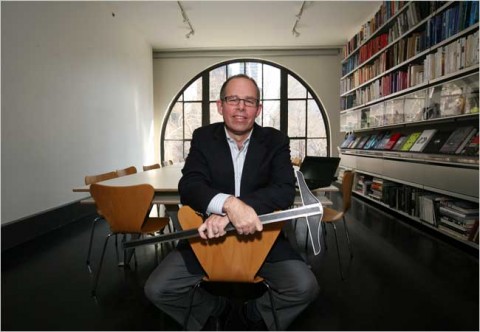
 Chester Higgins Jr./The New York Times
THE technology we have at our disposal is dazzling, and our efficiency is such that clients expect fast solutions and nearly instantaneous updates. We are proud to deliver them. Still, I wonder if we haven’t lost something in the process: the deliberation that comes with a slower pace, the attention to detail required when mistakes can’t be undone with the click of a mouse. Younger designers hearing me talk this way react as if I’m getting sentimental about the days when we all used to churn our own butter.
Drawing Board to the Desktop: A Designer’s Path, by Michael Bierut
(via designobserver)
Although I love computers and technology,
I have to agree with mr. Bierut.
What happened to craftmanship?
I graduated as an architect last year,
and I can’t even draw properly.
Nobody ever taught me that!
Feb 9th, 2009 / 10:59 am
To this day I keep my Deluxe GRAPHIC proportion dial and my Schaedler Rule next to my monitor. And hey you can always play air guitar with your t-square!
Feb 9th, 2009 / 11:11 am
I think Mr. Bierut makes a valid point, but we live in a world where designers use computers. We aren’t going to suddenly give up technology and go back to mocking up everything on boards with rubber cement and t-squares.
So rather than simply yearn for the past, why not offer some ideas on how we might work craftsmenship back into the modern design process. Seems more useful than simply writing an article about how great things used to be.
Feb 9th, 2009 / 12:54 pm
i think this is a nice sentiment. his idea of a slower pace and time for deliberation speaks to more than just design process and maybe about our culture in general… nice article.
Feb 9th, 2009 / 1:33 pm
But it’s not like t-squares, compasses, eraser shields, light-boxes, etc. are from that long ago.
Maybe we shouldn’t think of the shift as such a permanent thing? If fashion and music can make what was old new again, then why can’t graphic design do the same for grid paper and s-curves?
Feb 9th, 2009 / 2:12 pm
To be in a slow pace, we need a slow pace demands from our clients.
A clients that love to see and be part of the process instead of merely demanding the end results send via email.
Feb 9th, 2009 / 3:07 pm
i feel so privileged to have been able to start photography in a darkroom and my design with wax cards, photstats, and nonrepro blue. i was the kid in the art department and the only one there who knew how to use a computer, so i was trained in analog by the old guard and was auto-didactic in digital.
Feb 9th, 2009 / 4:36 pm
I’m a college student in design, and I’ve heard this sort of thing from many of my professors. I’m glad I was able to have a strong foundation in drawing and “hands on” craftsmenship in high school. I wish it were required of any designer getting into the business. I’m tired of people owning a couple of programs and calling themselves a designer.
Feb 10th, 2009 / 3:30 am
I’m an industrial design student at Georgia Tech and I really have to agree that something has been lost in the transition to digital. I am very thankful that while the school is incredibly technology-driven, my first year hear consisted of learning to draft, how to draw quick gestures, how to apply value with charcoal, developing good practices in using perspective, and framing your subjects. Now, further along in the program, I find myself increasingly sitting in front of a computer with Photoshop and SolidWorks open. There is no way that I could survive without Ctrl+Z.
This semester however I have an “old-school” instructor who will pin up his old marker and pen drawings, handcrafted with a care and attention to detail that are leagues beyond what our studio commonly produces. I feel the problem is that while we can work faster, we can’t think nearly as quickly as our tools can. We need to slow down and work on our ideas at the pace required to produce good design.
Feb 24th, 2009 / 11:14 am
My dream retirement would involve a wonderful log cabin in the mountains. Who needs a beach?
Oct 3rd, 2013 / 6:46 am
This video post is truly enormous, the noise feature and the picture feature of this video post is really awesome.
Oct 12th, 2013 / 12:34 pm
Hi there! I just would like to give a huge thumbs up for the great info you’ve gotten here on this post. I will be coming back to your blog for more soon.
Oct 14th, 2013 / 3:29 am
Truly when someone doesn’t know after that its up to
other users that they will assist, so here it happens.
Feb 22nd, 2014 / 9:01 am
Hello to every body, it’s my first visit of this weblog; this blog consiats
of awesome annd actually fine data in avor of visitors.
Apr 22nd, 2014 / 8:06 pm
I’ve learn several good stuff here. Certainly price bookmarking for revisiting.
I surprise how a lot attempt you put to create one of these magnificent informative web site.
Jun 21st, 2014 / 5:17 pm
The new design incorporates a removable hard
top, and a whole new construction of the monocoque passenger compartment.
Residential and commercial roofing in the Portland area doesn’t have
to involve a grief stricken experience. This will
keep it in place throughout the repair job and will also reduce
the odds of damaging gutters or eaves.
Jan 12th, 2015 / 2:33 pm