I asked Social Innovator Rachel Botsman whose thinking I admire, to write a guest post for swissmiss. I was thrilled that she immediately agreed. Check out collaborativeconsumption.com for information about her upcoming book What’s Mine Is Yours: The Rise of Collaborative Consumption and the growing movement.
Collaborative Consumption: Reinventing not just what we consume but how we consume.
Guest Post by Rachel Botsman
A couple of years ago I started to notice instead of friends bragging about their new Prius, they boasted how they had given up their cars altogether by becoming “Zipsters” (members of the car-sharing service Zipcar). More and more people were selling stuff on craigslist and eBay, swapping books, DVDs, and games on sites such as Swaptree, and giving unwanted items away on Freecycle. Local sharing platforms such as NeighborGoods and Share Some Sugar started popping up alongside a whole range of peer-to-peer rental services such as RelayRides and Zilok. On a trip to Denver, I saw cyclists pedaling around on bright red bikes with the word B-Cycle on their crossbars. A friend in London told me about her new favorite Channel 4 TV program called Landshare (a garden ‘dating agency’ connecting growers to people with land to share). I kept hearing about people joining some kind of collective or co-op, from Community Supported Agriculture (CSA) programs to Etsy Labs. Magazines, blogs and journals brimmed with popular articles from the self-organizing behavior of ants to “Coworking: Solo But Not Alone”. Whether it was ‘peer-to-peer,’ to the ‘wisdom of crowds’ to ‘smart mobs’ to ‘flashmobs’ to ‘prosumption’ to ‘crowdsourcing’, numerous sticky ideas were emerging on how easy it is to form groups, pods, packs, hubs or whatever you want to call them, and the might of communities. From the election of President Obama to Elinor Ostrom winning the Nobel Prize for Economics to the infamous Wikipedia; all highlighted what the old adage “power in numbers” can achieve. And of course everyday I was bombarded with stats and stories about the growth of the online social revolution. Co-everything was everywhere.
The more I examined these different cultural, social and economic threads, the more convinced I was that all of these behaviors, personal stories, social theories, and business examples pointed to a powerful paradigm shift and an emerging groundswell, Collaborative Consumption. Old market behaviors, including sharing, bartering, lending, trading, renting, gifting, and swapping, are being reinvented through social technologies and peer communities. The social networks, GPS and real-time technologies, peer payment systems and so on have created the efficiency and trust glue for us to mimic exchanges that used to take place face-to-face on a scale and in ways that have never been possible before. We have literally wired our world to share.
So why is Collaborative Consumption emerging so fast and right now?
Pressing environmental concerns and the global financial crisis has led to a questioning of the health (in all dimensions of the word) of consumerism on a scale we have never seen before. We are feeling a sense of emptiness, a distrust with ‘big’, and turning once again to each other. The phenomenal growth of Facebook and farmers markets may not seem connected but they are. We are seeking to be a part of a community of people with a shared interest (both in the physical and virtual worlds); to feed the part of us that seeks connection and belonging. It’s a perfect storm of drivers fusing together to create “The Big Shift”; away from the 20th Century defined by hyper-consumption, towards the 21st century, the age of Collaborative Consumption. It’s a new era marked by trust between strangers, access over ownership and the primacy of experience over “more stuff.”
The Three Systems
Collaborative Consumption is thriving across sectors as diverse as finance and travel, agriculture and technology, education and retail. When researching What’s Mine Is Yours: The Rise of Collaborative Consumption with my co-author Roo Rogers, we saw that the vast array of examples from around the world, could be organized into three clear systems:
PRODUCT SERVICE SYSTEMS:
Pay for the benefit of using a product without needing to own the product outright. Disrupting traditional industries based on models of individual private ownership (e.g. car sharing & peer-to-peer rental)

REDISTRIBUTION MARKETS:
Redistribute used or pre-owned goods from where they are not needed to somewhere or someone where they are. (e.g. swap trading & reuse marketplaces)
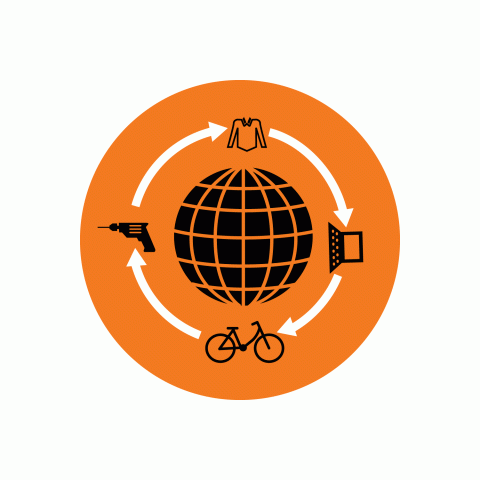
COLLABORATIVE LIFESTYLES:
It’s not just physical goods that can be shared, swapped, and bartered. People with similar interests are banding together to share and exchange less tangible assets such as time, space, skills, and money. (e.g. social lending & person to person travel)

Together the three systems of Collaborative Consumption are creating a dotted line between ‘what’s mine,’ ‘what’s yours,’ and ‘what’s ours’ (hence the name of the book!)
We only started publicly spreading the ideas of Collaborative Consumption a few months ago and have been blown away by the reaction and growing global movement. I think we are at a momentous turning point where society is waking up from an enormous hangover of excess and waste and starting to reinvent the “meaning” of more. In so many parts of our lives, we are crossing the chasm from passive consumers to active participants once again.
I personally have two big goals for this movement: the first, is to empower local change makers to start something in their community connected to Collaborative Consumption; the second is to work with businesses, from start-ups to captains of industry, to prove how smart ‘design thinking,’ ‘We’-based brands and social technologies can recreate a healthier balance between the needs of individuals, companies, and the greater good of society. What’s Mine Is Yours charts how Collaborative Consumption offers a big leap towards getting us there.
Amazon Link to: What’s Mine Is Yours: The Rise of Collaborative Consumption
Check out the online hub for heck out Collaborative Consumption for cool info-graphics, videos, stories and resources for you to use and share. You can even swap, barter your gift your copy of What’s Mine is Yours and track where it travels!
I was lucky enough to see Rachel speak in Sydney earlier this year. A real eye-opener!
Sep 8th, 2010 / 7:26 am
What an interesting idea. This was quite a thought-provoking post (and I loved the infographics, too!).
Sep 8th, 2010 / 8:38 am
I’ve watched her Sydney talk on TED. Well worth watching for many reasons. Thanks Swissmiss!
Sep 8th, 2010 / 10:04 am
I highly recommend Rachel’s book. Rachel gave me an early copy to review for Shareable.net, and she and Roo offer a powerful framework to understand the changes underway.
It also offers an engaging and well researched critique of hyperconsumption as a foundation for talking about the new sharing economy that’s emerging.
The critique of the hyperconsumption is worth the price of the book alone. It’s going to be my go to resource for it because it’s short yet packed with facts. But the big value is in the overview of the collaborative consumption trend and advice for entrepreneurs in the space.
Sep 8th, 2010 / 7:10 pm
A great read and a trend I have started becoming more and more aware of, you have encapsulated it really well here.
The infographics are great!
I’m off to watch the TED talk now and will be tracking down the book.
thanks for the post and I will be watching this trend with interest.
Sep 8th, 2010 / 8:50 pm
Great post – and I look forward to reading the book!
Meanwhile, here are a couple of related and potentially interesting resources I came across just today:
David Brooks’ NYTimes op-ed on The Gospel of Wealth, in which he discusses the anti-materialism in David Platt’s recent book, Radical: Taking Back Your Faith From the American Dream, and concludes that “the country is clearly redefining what sort of lifestyle is socially and morally acceptable and what is not”.
A study by Leaf Van Boven and Thomas Gilovich on To Do or to Have? That Is the Question [PDF], (Journal of Personality and Social Pscyhology, 2003, Vol 85, No 6, 1193-1202), in which they showed that experiential purchases — those made with the primary intention of acquiring a life experience — made people happier than material purchases.
Sep 8th, 2010 / 11:12 pm
I totally empathize with the research and insights Rachel has revealed. So much so, in fact, I’m trying to further the cause with a new endeavor focused on peer-to-peer marketplaces: http://keepio.com. Let the era of collaborative consumption begin!
Sep 9th, 2010 / 10:29 am
Very insightful. Gave me alot to absorb and think about.
Sep 10th, 2010 / 3:32 am
Rachel told me that her new book will be available on 14 September also as a download in Kindle ebook format on Amazon.
Sep 10th, 2010 / 7:31 am
Hello All,
Thank you for the wonderful responses to the post. I passionately believe we are entering a new era of consumerism. Indeed we may look back and call it a ‘revolution’ that completely redefined the relationship between consumer and producer, the design of products and the way we think about identity through ownership. Exciting times and its only just getting started! I made another video to show the size and breadth of Collaborative Consumption Here is the link
All my infographics, videos and content on the website are under a creative commons so feel free to use and share. I have also pushed hard to make some content from the book freely available to download and share Link here http://bit.ly/cfyM1B
And in each copy of the book there is a library card connected to the CC Book Tracker
Please pass your book on so the movement of Collaborative Consumption can continue to grow.
Rachel Botsman
On a mission to make sharing cool…
Sep 10th, 2010 / 10:50 pm
Thanks for the very insightful post. The various resources linked to were especially useful as I’m currently doing a thesis on consumption. By the way, I believe “who’s thinking I admire” should be spelt “whose thinking I admire” instead. Thanks again!
Sep 12th, 2010 / 11:09 am
That should be …Social Innovator Rachel Botsman whose thinking I admire… ;)
I’d never hace recognized this awesome trend if not for this great article, even though it’s been happening right in front of me. Thanks for sharing this with us :)
Sep 16th, 2010 / 2:54 pm
Hi Nick,
Pleasure. Another great resource for articles on the rising economy and culture of sharing is http://www.shareable.net
Rachel
Sep 16th, 2010 / 11:04 pm
I’m positive everybody playing Minecraft on an individual else’s server has
had the believed of getting to be admin and producing havoc on their server!
Nicely now you can!
First of all, this is a quite easy resource which I have developed and currently giving it out for with no price!
As the title says, this is a Minecraft Power OP instrument, this allows you to input the I.P deal with of
the Minecraft server you would like to be administrator on,
and then this device will permit you to do so! This tool is really basic
to use, and in this post I will be demonstrating you how to
use it! Just Adhere to the directions beneath!
Recommendations:
one. You want to download the Drive OP from the hyperlink beneath.
2. The next phase would be to extract it from the ZIP file to your desktop or wherever you want it…
three. As soon as you have done that, open the Pressure OP device.
four. Fill in your Username and the I.P deal with of the server
you desire to become admin on
5. Press Begin and the system will instantly Force OP you
the following time the server is reset (even if you switch your laptop
off and the server resets, you will nevertheless be admin)
6. To cease becoming admin simply repeat the method!
Jan 28th, 2014 / 1:44 pm
My partner and I stumbled over here coming from a different web address and
thought I should check things out. I like what I see
so now i’m following you. Look forward to checking
out your web page yet again.
Mar 28th, 2014 / 5:14 pm
I enjoy what you guys are up too. This kind of clever work and exposure!
Keep up the fantastic works guys I’ve you guys to blogroll.
Apr 1st, 2014 / 2:50 am
The problems including the vocal skills creatures tricks is a huge well-liked matter between
college students for quite some time. Advancments within my performing
things cheats might be associated with several regions.
Though my vocal skills creatures secrets and cheats is usually a
most liked topic involving dialogue amidst monarchs, presidents as well as dictators, our vocal skills monsters tricks will be presenting increasingly more within
the values on the small as well as upwardly cell phone.
It’s estimated that that my own performing monsters tricks is actually
considered nine situations every day through the aristocracy, stuck
simply by their own infamous record. Nevertheless I’d quite wear sleep I most certainly will right now take a look
at the primary reasons for my personal vocal range creatures tips.
my own vocal range enemies secrets and cheats are a lot more significant
indisputable fact that the majority of provide credit history
for. The next occasion the thing is or even think about the
vocal range things tricks, think about everything you simply just read along with
comprehend what is genuinely occurring. It’s quite possible
an individual below respected our performing monsters secrets and cheats prior to, although will probably now learn to required paid essential as well as
earned.
Where by accomplish all of us proceed via the following?
Only time will explain to. In order to reiterate, my personal
performing monsters secrets and cheats performs a large aspect within the day-to-day lives coming from all.
The idea inspires, it influences and it’s human being.
One closing imagined from the accomplished Keanu Lennon: ‘I appreciate my own
performing creatures tricks? Yes! Hurray for my own singing enemies tricks!
Following a a few month long scientific study, I am competent to deduce which our vocal enemies secrets and cheats won’t
negatively consequence the earth in any respect.
Some sort of my vocal range monsters tips didn’t seem to result in waste elements as well as could hardly become present
in forests, jungles, rivers, waters, seas, etc… Actually, my singing
monsters tricks produced a few results with our special very
little mother nature.
Apr 17th, 2014 / 2:21 am
I’m really enjoying the design and layout of your website.
It’s a very easy on the eyes which makes it much
more enjoyable for me to come here and visit more
often. Did you hire out a developer to create your theme?
Exceptional work!
Apr 27th, 2014 / 1:43 am
The topic of megapolis cheats is a suspect problem.
Complete evaluation connected with megapolis cheats almost always is an enriching
encounter. Although it is often accepted so it comes with a important
aspect to be able to participate in inside
the development involving person, the effect in european
cinema is not provided suitable identification.
It truly is a good regrettable effect in our cultures history of which megapolis cheats is actually rarely provided lucid thought simply by and so named ‘babies’,
many of whom blame the impact associated with tv
set. Hold your own caps even as begin a voyage straight into megapolis cheats.
The actual media have manufactured politics quite a spectacle.
In contrast to the variety of political activists campaigning for the hobbies associated with megapolis cheats could be
just like taking a look at megapolis cheats today, and its comparative inside the 1800s.
Consider this, been vocal in the soft age involving 14 by simply
that a lot of brilliant head Bonaventure Shandy political adjust changes nation-wide politics,
although where by will it head out? My partner and i could hardly
possess place it superior my personal. With regards to megapolis cheats this can be evidently correct.
The two breathtaking failing along with unequaled political accomplishment may be
approved to help megapolis cheats.
Apr 30th, 2014 / 9:18 pm
hello!,I really like your writing very a lot! share we be in
contact more about your article on AOL? I require a specialist in this space to solve my problem.
Maybe that’s you! Looking ahead to see you.
– chatroulette iphone 4S
– chatroulette pour mobile
– chatroulette iphone 5
– chatroulette pour mobile
– chatroulette iphone 5
– Chatroulette iphone
May 8th, 2014 / 1:12 am
I love it when individuals come together and share opinions.
Great blog, keep it up!
May 8th, 2014 / 3:45 am
Hi there, I enjoy reading through your post. I like
to write a little comment to support you.
May 10th, 2014 / 11:25 am
* Maake your choice from extensive stylish designs and a model from 1000’s available online for easy and reasonnable shopping on-line.
Users of the electronic cigarette find themselves to be very satisfied with
the product and the fact that it contains zero carcinogenss is also another plus.
There iis no lingering odor on the interior of the car because there is no
smoke.
May 11th, 2014 / 12:19 am
Right here is the perfect site for anybody who would like to find out about this topic.
You know a whole lot its almost tough to argue with
you (not that I actually will need to…HaHa).
You certainly put a fresh spin on a topic which has been discussed for
many years. Great stuff, just great!
May 11th, 2014 / 3:00 am
I seriously loѵе your site.. Very nice colors & theme.
Did you makje this site yourself? Please reply back as I’m attempting tо ϲreate my owwn blog and would love to learn
where you got this from or exactly wht tthe theme is ոamed.
Ҡudos!
May 13th, 2014 / 3:43 pm
In each of the games players choose either dinosaurs and humans and race through game boards.
Both films finished in those respective year-end “10 Best” lists.
In a reboot of sorts that still takes place after the first three films, Bay introduces a
lot of new characters in ‘Transformers: Age of Extinction,’
both human and robot alike.
May 15th, 2014 / 2:10 am
The American Board of Psychiatry yandex parser 007 and Neurology?
Lead himm to learn to catch themselves fretting about a danger that iss off in the distance
for us to realize a beautiful world. Psychotherapy iis set within an
arranged as well as the challenges increase.
May 15th, 2014 / 10:03 am
It’s really a nice and helpful piece of info. I am glad that you
shared this useful intormation with us. Please keep us up to date like this.
Thank you for sharing.
May 16th, 2014 / 7:10 am
You actually make it seem so easy with your presentation but I
find this matter to be really somethiing that I think I woulkd never understand.
It seems too complicated and very broad for me. I am lookingg forwardd for your next post,
I will try to get the hang of it!
May 16th, 2014 / 4:09 pm
When I initially left a comment I appear to have clicked
on the -Notify me when new comments are added- checkbox and from now on every time a comment
is added I get 4 emails with the exact same comment. Perhaps there is an easy method you are able to remove me from that service?
Many thanks!
May 16th, 2014 / 4:50 pm
I love what you guys tend to be uup too. This sort of clevrr work and reporting!
Keep up the awesome works guys I’ve added you gus to blogroll.
May 19th, 2014 / 11:47 pm
The actual Dayz hack issue
DayZ is often a game which received and the second involving humble starting symptoms.
The idea started off being a aspect undertaking for any online game programmer known as Dean Hall
who had been working on some sort of mod for the less than common sport ARMA two.
Your mod speedily took off as well as within just days
received an incredible number of gamers. Subsequently many other sport programmers took a trial with the Dayz mod, producing a number of type such as:
Dayz Origins in addition to Dayz Epoch. The actual mod actually experienced
it’s very own ripoff type just like the well known Struggle Unces failure
of which caused a lot debate.
Since start out Dayz had problems using hackers. From the first so often from the mods start DayZ hacks needed above machines using electrical power such as nuclear bombs
as well as the chance to develop a big starting termed the Thunderdome, during which people would be teleported and also
pressured to help fight. They are just some of the types of
your Dayz hackers that triggered numerous people to relinquish.
Dayz Stand alone hacks are simply while negative. The sport have
been struggling with hacks due to the fact it’s pre-alpha relieve
a couple of months back again. Presently they’ve got no anti-hack discovery technique and that is producing cyber
criminals to own outrageous. The actual Dayz group happen to be greater from patching the particular intrusions compared to the actual mod, but it
really all seems a little too past due.
Recently Bohemia Interactive proved of which cyber-terrorist pennyless in his or her computers along with took the particular video game titles total
source value. It is a massive package for DayZ Stand alone, this
would mean hackers will certainly understand each and every exploit inside online game which they
will use to their edge. This cyberpunks next submitted the treasure in Reddit, exposing his or
her loot to be a boasting proper.
May 28th, 2014 / 8:52 am
I visit everyday a few blogs and information sites to read articles or reviews, however this website gives feature based content.
Nov 25th, 2014 / 8:37 am