The Farmer & Farmer Review

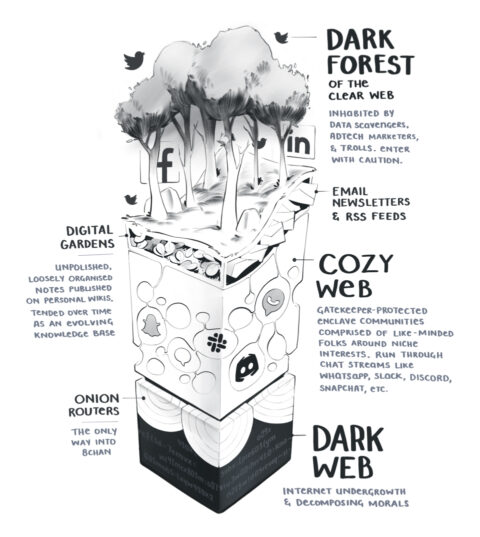
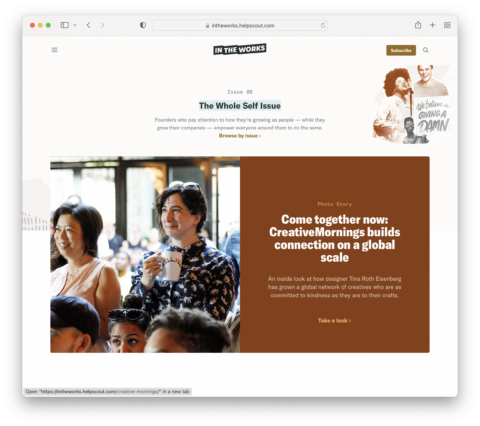
The Farmer & Farmer Review is a site by Jonathan Harris and Sep Kamvar on which they publish essays from leading practitioners in technology and the arts, exploring the relationship between humans and technology. File that under food for thought!

(Thank you Youngna)

New York City guidebook from 1916

“The first characteristic of New York, which impresses the stranger from abroad, and in a less degree from other American cities, is its atmosphere of breathless hast, its pervading sense of life keyed to an abnormal tension.”

“One direct consequence of this unending hurry, which the visitor is quick to feel, is a certain brusqueness and lack of civility as compared with other cities. Not that the great, motley, democratic middle class is deliberately rude to strangers; it simply lacks the time for the little courtesies of life, and grudges two words where one can be made to answer.”

Excerpts from a New York City guidebook from 1916.

(via Kottke)

Should I Check my Email?

Should I Check my Email? A flowchart by Wendy MacNaughton for a Forbes article on how and why to ignore your inbox.

(via Explore)

Everyone’s Job

“Don’t let your company culture become one where certain people are too good to do the jobs that need doing. Making shit work is everyone’s job.”

Quote from this 37Signals Blog Post

Sunscreen Facts

Sunscreens prevent sunburns, but beyond that simple fact surprisingly little is known about the safety and efficacy of these ubiquitous creams and sprays.

Article: Sunscreens Exposed: 9 surprising truths

On Collaboration

“Connecting online tools to offline communities speaks to a larger trend—a growing value for face-to-face interaction.”
- Craig Shapiro

Article: On Collaboration, by Craig Shapiro

Doing What you Love

“To be happy I think you have to be doing something you not only enjoy, but admire. You have to be able to say, at the end, wow, that’s pretty cool. This doesn’t mean you have to make something. If you learn how to hang glide, or to speak a foreign language fluently, that will be enough to make you say, for a while at least, wow, that’s pretty cool. What there has to be is a test.”
- Paul Graham

Article: How to Do What you Love, by Paul Graham

The Brain on Love

“A RELATIVELY new field, called interpersonal neurobiology, draws its vigor from one of the great discoveries of our era: that the brain is constantly rewiring itself based on daily life. In the end, what we pay the most attention to defines us. How you choose to spend the irreplaceable hours of your life literally transforms you.”

Article: The Brain on Love, by Diane Ackerman

(thank you Keren)

The Social Life of Small Urban Spaces

Small fragment of William H. Whyte’s witty and original film about the open spaces of cities and why some of them work for people while others do not.

(via an article by Kio Stark over at the The Atlantic)

work for the right reasons

“Make the client the focal point of your business again. Without clients you will not make money. In fact, you will not exist. Weed out the morally bankrupt people, no matter how much money they make for the firm. And get the culture right again, so people want to work here for the right reasons. People who care only about making money will not sustain this firm — or the trust of its clients — for very much longer.”

“Greg Smith in his resignation letter to Goldman Sachs: Why I am leaving Goldman Sachs

(via @espiekermann)

Change your language.

Instead of saying “I don’t have time” try saying “it’s not a priority,” and see how that feels. Often, that’s a perfectly adequate explanation. I have time to iron my sheets, I just don’t want to. But other things are harder. Try it: “I’m not going to edit your résumé, sweetie, because it’s not a priority.” “I don’t go to the doctor because my health is not a priority.” If these phrases don’t sit well, that’s the point. Changing our language reminds us that time is a choice. If we don’t like how we’re spending an hour, we can choose differently.

Fascinating Wall Street Journal Article on being busy.

(via Joanna Goddard)

The Great Discontent

photo by Stefan Falke for thebrander.com

I had the honor to chat with Ryan and Tina Essmaker of The Great Discontent, a journal focusing on creativity, risk, and what connects us as artists.

Our conversation is currently featured on their lovely site. Such an honor!

Also, make sure to check out these previous conversations with Dan Mall, Lisa Congdon, Phil Coffman, Mandy Brown, Kyle Steed, Chris Glass and Dan Rubin.

5 Minutes

“Man, give it five minutes.”
- Richard Saul Wurman

A quote taken from an excellent post by Jason Fried about our tendencies of pushing back, dismissing other people’s ideas too fast.

(via @brownthings)

The Single Sentence Email Project

In my desperation of finding a solution to my guilt-inducing-email-problem I am considering The Single Sentence Email Project:

“Respond to emails with as few words as possible. Aim for a sentence, but if just a word will do, use it.* It will take practice, and some might dislike it. I argue that this is a fair trade for getting more time to work (and live) productively.”

But I of course fear that my short reply will come across as rude. What is better: Getting a brief reply or none at all? Maybe Five Sentences is a good middle ground.

On Surprise e-Intros

I have currently 6 guilt-inducing e-introductions sitting in my inbox, flagged of course. While I am extremely grateful for being introduced to interesting folks, I do not appreciate surprise-introductions. I don’t want to be that person that doesn’t reply, or simply doesn’t have time to meet up for coffee or to have lunch. I know, that all of these introductions are meant well, I would just simply appreciate to be asked first, if an introduction is ok.

I fully agree with Fred Wilson’s post from 2009 on email intro etiquette:

“When introducing two people who don’t know each other, ask each of them to opt-in to the introduction before making it.” – Fred Wilson

The Double Opt-In Introduction

(thanks Cameron)

An Important Time for Design

“If we want to really show what design is and what it can do, we need to get design elevated to the partner level. Partners have major equity stakes, real decision-making power, and are involved in product development from the beginning.” – Cameron Kozcon

A quote I keep coming back to. Taken from an A List Apart post written by my studiomate and friend Cameron Kozcon: An Important Time for Design.

Kern & Burn

Kern & Burn is an online and print publication that curates discussions, interviews and essays about design entrepreneurship

A fold

Thanks to the above graphic and this post over on brain pickings I will never look at a simple fold the same way again. Same goes for an ant.

New Digital Charter

Yesterday it was revealed that embarrassing, inaccurate or simply personal data will have to be deleted from the internet and company databases if consumers ask, under a new set of European laws.

Article: BBC ‘will delete all users’ data’

(via @piersfawkes)

On Parenthood

Jeff Atwood’s graph on what it means to be a parent. Read his post here. Best article I’ve read so far on the topic of parenthood.

(thank you Paul)

Time For a Studiomates Dog

Researchers found that having dogs present increases collaboration. …

I’d say it’s time to get a studiomates dog as it is supped to improve productivity and camaraderie in your work environment. The finding is part of a study by Crain University. Read about it in this interesting article over at 99percent on 8 Counter-Intuitive Ways to Improve Your Well-Being & Creativity.

The Lost Art Of Design Etiquette

Not sure how I missed this fantastic post on The Lost Art Of Design Etiquette by Dan Rose. I especially applaud the ‘name your layers’ portion of the post.

Art & Exploration

Having grown up on the Swiss country side and being allowed and taught to be adventurous and self-sufficient at a very early age, the below excerpt from Michael Chabon’s Manhood for Amateurs makes me sad about living in a city with kids.

“What is the impact of the closing down of the Wilderness on the development of children’s imaginations? This is what I worry about the most. I grew up with a freedom, a liberty that now seems breathtaking and almost impossible. Recently, my younger daughter, after the usual struggle and exhilaration, learned to ride her bicycle. Her joy at her achievement was rapidly followed by a creeping sense of puzzlement and disappointment as it became clear to both of us that there was nowhere for her to ride it—nowhere that I was willing to let her go. Should I send my children out to play?

There is a small grocery store around the corner, not over two hundred yards from our front door. Can I let her ride there alone to experience the singular pleasure of buying herself an ice cream on a hot summer day and eating it on the sidewalk, alone with her thoughts? Soon after she learned to ride, we went out together after dinner, she on her bike, with me following along at a safe distance behind. What struck me at once on that lovely summer evening, as we wandered the streets of our lovely residential neighborhood at that after-dinner hour that had once represented the peak moment, the magic hour of my own childhood, was that we didn’t encounter a single other child.

Even if I do send them out, will there be anyone to play with?
Art is form of exploration, of sailing off into the unknown alone, heading for those unmarked places on the map. If children are not permitted–not taught–to be adventurers and explorers as children, what will become of the world of adventure, of stories, of literature itself?”

(via Raul)

SO&SO

SO&SO is a lovely new short-form journal for the wandering interneteer. The current, second edition tries to resolve the Atheist / Agnostic distinction. Interesting.

(Hat tip to the creator Alasdair Monk.)